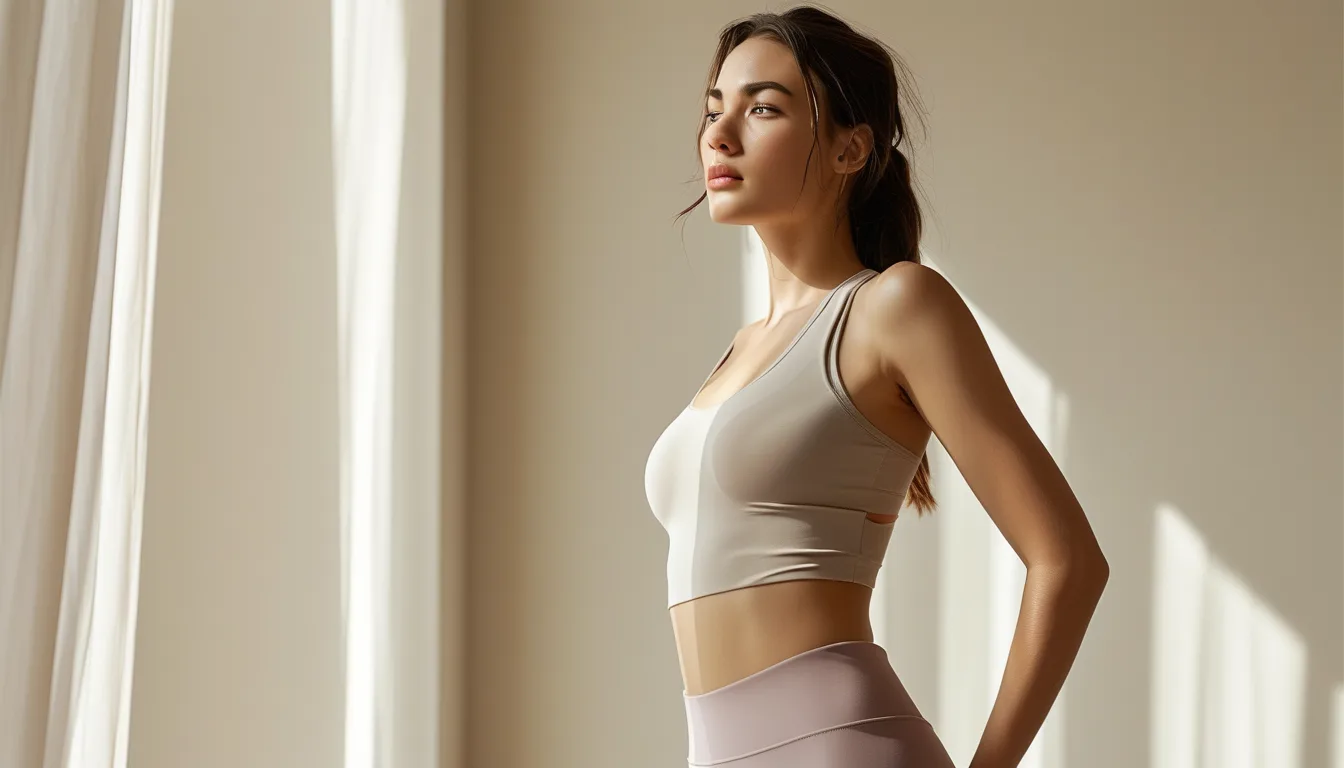
High-Rise vs Super-High-Rise: Which One Actually Stays Put When You Sit?
Quick Answer: Super-high-rise sits above the natural waist and compresses the softest, most mobile part of your midsection — great standing, prone to folding when you sit. High-rise sits at or just above the navel, where your torso bends least. If your waistband rolls when you sit, the rise is usually too high for your torso length, not too loose. Measure from your natural waist to your hip crease before you buy.
You bought the super-high-rise because it looked incredible in the changing room mirror. Then you sat down at your desk and it folded itself into a soft croissant somewhere below your ribs.
Rise is the single most under-discussed fit variable in activewear, and torso length matters more than size does. The third section has the measurement that settles it.

What is the actual difference between high-rise and super-high-rise?
It is a measurement, not a vibe, though brands treat it like one.
Rise is the distance from the crotch seam to the top of the waistband. In activewear, high-rise generally lands somewhere around 25 to 28 cm, and super-high-rise around 30 to 33 cm, though the same label can mean genuinely different garments across brands — one brand’s high-rise is another’s super.
Where they land on the body is what matters:
High-rise sits at or just above the navel, roughly at the narrowest part of your natural waist or a touch below.
Super-high-rise sits above the natural waist, sometimes reaching the bottom of the rib cage.
That difference is not cosmetic. The area above your natural waist is soft tissue over a mobile section of spine. When you sit, hinge, or bend, that region compresses and changes shape substantially. The area at your natural waist changes shape far less.
So the trade is straightforward: super-high gives more coverage and a longer smooth line standing up, and puts the top of the band exactly where your body changes shape most when you move. High-rise gives slightly less coverage and sits on more stable real estate.
Neither is better. They are better at different things, and which one suits you depends less on your size than on the length of your torso.
Why does the waistband roll or fold when I sit?
Four causes, and only one of them is about the leggings being the wrong size.
Cause 1: The rise exceeds your torso length. If the band lands where your rib cage begins, there is nowhere for it to go when you fold forward. It has to buckle. This is the most common cause and no amount of sizing down fixes it — sizing down just adds pressure to the fold.
Cause 2: The band is too loose at the top edge. Some waistbands taper the wrong way and finish wider than your torso at that height. A gap at the top edge is an invitation to roll.
Cause 3: The fabric has no vertical recovery left. After enough wash cycles, a band that used to spring back just stays folded. If your oldest pair rolls and your newest does not, it is wear, not fit.
Cause 4: You are sitting more than you think. A rise that behaves for a workout that lasts fifty minutes can misbehave over an eight-hour day of desk work. The garment is not failing — it is being asked to do a different job.
Quick diagnostic: sit down, then look at where the fold starts. If the fold begins right at the top edge of the band, it is a fit or looseness issue. If the whole band collapses and slides downward as a unit, the rise is too tall for your torso.

How do you measure your torso to pick the right rise?
Two minutes with a soft tape and you stop guessing.
Measurement 1 — natural waist to hip crease. Stand relaxed. Find your natural waist by bending sideways; the crease that forms is it. Measure straight down from there to the crease at the front of your hip where your leg meets your torso.
- Under about 18 cm: short torso. Super-high-rise will very likely sit into your ribs and fold. High-rise, or even a mid-high, will behave better.
- 18 to 22 cm: average. Both work; choose by activity.
- Over about 22 cm: long torso. Super-high-rise finally makes sense — on a long torso it lands at the natural waist rather than above it, and standard high-rise may sit lower than you want.
Measurement 2 — seated waist. Sit down and measure around your midsection at the height the band will sit. Compare it to your standing measurement. A difference of more than about 5 cm means your midsection changes shape a lot when seated, and you should favor a band with real vertical structure — bonded, wide, and firm rather than thin and stretchy — regardless of rise.
Then check the garment’s stated rise rather than the marketing word. Most decent brands list it. A stated rise within 2 cm of your natural-waist-to-crease measurement plus your preferred coverage is the one that stays put.
Myth vs Fact: the rise and smoothing questions
Myth: A higher rise always looks smoother.
Fact: Only while you are standing still. A higher rise covers more, which is genuinely flattering in a mirror. But the moment you sit, a rise above your natural waist creates a horizontal fold that is more visible under a fitted top than the edge of a lower band would have been. Coverage and smoothness are not the same thing once you move.
Myth: If it rolls, size down.
Fact: Sizing down usually makes rolling worse. A tighter band on the same too-tall rise increases pressure at the fold point and can create a bulge above the band. The variable to change is rise or band construction, not size.
Myth: A wider band is always more secure.
Fact: Width helps only if the band has vertical structure. A wide band of the same thin fabric as the leg just gives you more material to fold. What actually resists rolling is a band that is bonded, double-layered, or reinforced — you can feel the difference by pinching it. A narrow structured band beats a wide floppy one every time.
Myth: Drawstrings solve everything.
Fact: They solve slipping down, not folding over. Different problem, different fix.
FAQ: Rise and Fit Questions, Answered
What rise should I choose for a desk job?
High-rise, with a structured band. You will spend most of the day at roughly 90 degrees at the hip, which is the position that punishes an over-tall rise most. A band sitting at or just below the natural waist has stable tissue underneath it and far less to fold.
Is super-high-rise better for postpartum comfort?
It can be, and it depends on where you are sensitive. Many people find a band that sits well above a tender area is more comfortable than one sitting directly on it. But if you are dealing with a C-section scar or abdominal separation, comfort and support needs are individual — a band that presses at exactly the wrong height is worse than a lower one. Try before committing, and check with your provider about compression if you are early postpartum. This is general information, not medical advice.
How do I stop an existing pair from rolling?
Fold the band down deliberately once, into a clean single cuff. A controlled fold looks intentional and stays flat, whereas an accidental roll creates a lumpy ridge. It is a workaround, not a fix, but it makes a pair you already own wearable for another season.
TL;DR:
- Super-high-rise sits above your natural waist, on the part of your torso that changes shape most when you sit.
- Rolling is usually a rise-too-tall-for-your-torso problem, not a size problem — sizing down makes it worse.
- Measure natural waist to hip crease: under 18 cm favors high-rise, over 22 cm makes super-high-rise work.
- Band structure beats band width — pinch it, and pick the one you can feel is bonded or double-layered.
- Choose rise by activity: high-rise for long seated days, super-high for standing, lifting, and long lines.
The genuinely useful thing about rise is that it is a fixable mismatch rather than a body problem. Two people can love and hate the same pair of leggings for entirely reasonable reasons, and it usually comes down to a few centimeters of torso. Once you know your number, the changing room stops being a lottery.
See It in Motion
Seen here: Maternity Capris with Side Pockets — shop it on bubblelime.com
Keep Reading
This article is for general informational and styling purposes only. Fit, sizing, and product availability may vary.