Why Seamless Shapewear Shows More Under Thin Fall Knits
Quick Answer: Fine knits cling and drape rather than holding their own shape, so they follow whatever is underneath instead of skimming over it. Seamless shapewear is smooth but not invisible - it has edges, thickness changes, and a different surface friction from skin, and a thin knit reveals all three. Longer lengths, matched thickness, and a smooth slip layer solve it better than a smoother garment does.
All summer this piece was undetectable under cotton tees and structured dresses. Then you put on a fine merino sweater and there is a visible line across your midsection that everyone can apparently see except you until you saw the photo.
The shapewear did not change. Autumn knitwear behaves completely differently from summer wovens, and the difference is worth understanding before you buy a smoother version of something that is already smooth.
Why do fine knits reveal what cotton hid?
Because a knit is a flexible structure and a woven is a rigid one, and rigidity is what hides things.
A woven cotton shirt or a structured dress holds its own shape. It bridges across small changes underneath, the way a stiff sheet of paper lies flat over a small bump. That bridging is why summer clothing forgives so much.
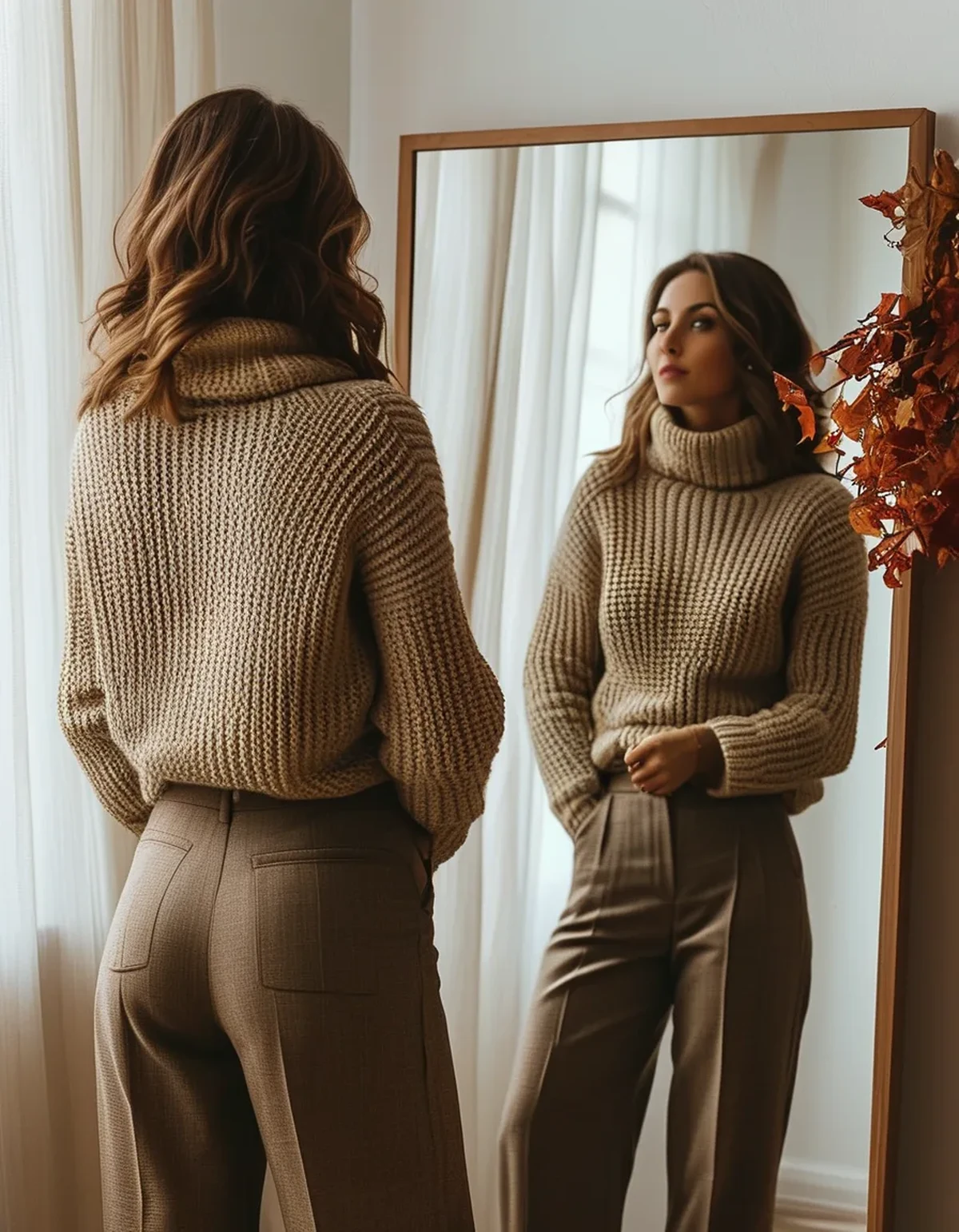
A fine knit does the opposite. It is made of loops, it stretches in every direction, and it drapes onto whatever it meets rather than spanning across it. Every edge, ridge, and change of thickness underneath becomes part of the surface you see.
Friction makes it worse. Shapewear surfaces have a different grip against fabric than skin does. A knit slides freely over skin and catches slightly on the shapewear’s surface, so the sweater sits differently across the two zones and creates a visible boundary right where the garment ends.
And static arrives with the heating. Dry indoor air in autumn generates static that pulls a fine knit tight against whatever is beneath. This is the single most underrated reason autumn outfits reveal underlayers that summer outfits did not.
Thickness transitions are the actual culprit, more than the shapewear itself. Wherever the garment goes from two layers to one - the top edge, the leg opening, a reinforced panel - there is a step in thickness, and a thin knit renders that step faithfully.
What actually solves it?
Managing the transitions rather than chasing a smoother garment.
Go longer, so the edge lands somewhere the outfit is already thick. A hem that ends under a waistband, under the bust seam of a bra, or below the hem of the top itself is a hem nobody can see. This is the highest-return fix and it usually means buying a longer piece rather than a better one.
Match the thickness across the whole piece. A garment with heavy reinforced panels and thin mesh sections has a lot of internal transitions, and every one of them can show. A single, evenly weighted piece with fewer zones is a better choice under fine knits even if it shapes slightly less aggressively.
Add a slip layer over the top. A thin, slippery camisole or half-slip between the shapewear and the knit lets the sweater glide across the whole torso instead of gripping in patches. This solves both the friction problem and most of the static problem at once, and it is the trick that makes an otherwise unwearable combination work.
Deal with static directly. Anti-static spray, a fabric softener rinse on the knit, or a slip layer in a natural fiber. Static is doing more work here than most people assume.
Consider whether the knit is the problem. A slightly heavier gauge, a ribbed texture, or a knit with some structure hides everything a superfine jersey shows. Texture is your ally - a cable, a rib, or a marled yarn breaks up the surface and disguises what a flat fine knit displays.
And test in the right conditions. Check in bright directional light, sitting as well as standing, and preferably in a photo. A shape that is invisible standing in a dim bedroom can be obvious sitting down in a bright office.

Myth vs Fact: Shapewear Under Autumn Layers
Myth: Seamless means invisible. Fact: Seamless means no seams, which is only one of several ways shapewear shows. Edges, thickness transitions, and surface friction all remain, and a fine knit picks up all of them.
Myth: Sizing down gives a smoother line. Fact: Sizing down increases compression at the edges, which makes the boundary step larger and more visible, and it creates roll-over at the top. Correct size or one up with a longer cut is smoother in practice.
Myth: Nude is the safe color under everything. Fact: Under thin light-colored knits, matching the garment to your own skin tone matters far more than the word nude on a label. Under dark knits it is irrelevant. Match to skin, not to a category.
Myth: More expensive shapewear is more invisible. Fact: Price buys comfort, durability, and better fabric, and none of those change the physics of a thickness transition under a fine knit. A longer inexpensive piece frequently outperforms a shorter expensive one.
Myth: If it shows, you need stronger shaping. Fact: Stronger shaping usually means firmer panels and more pronounced edges, which shows more. The direction of travel for invisibility is smoother and more even, not firmer.
Myth: Layering more will hide it. Fact: Layering a fine knit over a fine knit stacks the problem. It is the fabric type that hides things, not the number of layers.
How should you build the outfit from the skin out?
In order, checking each layer before adding the next.
Start with the length decision. Decide where the shapewear will end, and make sure that point is covered by a waistband, a seam, or the outer garment’s hem. Everything else is easier once the edge is hidden.
Check the bra and shapewear boundary. Where a shaping camisole meets a bra band there is a double thickness zone that shows under fine knits as clearly as any hem. Either overlap them fully or choose a single piece that does both jobs.
Add the slip layer if the knit is fine. As a default, not as a rescue. Thin, slippery, and one size that skims.
Then the knit, and check it in a mirror while sitting. Sitting compresses the midsection, shifts the shapewear edge, and is where problems appear.
Then the outer layer. A structured blazer, a jacket, or a coat solves a surprising amount by simply not being a fine knit across the areas that were showing.
And keep a photo check in the routine. Your mirror gives you one angle in one light. A quick phone photo shows you what the room sees, and it is the only reliable test for this particular problem.
A final practical note about the season. Autumn dressing means moving between a cold street and an overheated office all day, and shapewear worn under multiple layers in a warm room gets uncomfortable in a way it did not in a single summer layer. Breathability and a genuinely correct size matter more in the layered months, not less.
FAQ: Shapewear and Knitwear Questions, Answered
Does a bodysuit work better than separate pieces under knits?
Usually yes, because it removes the waist transition entirely - one continuous thickness instead of two edges meeting. The trade-off is convenience, which is a real consideration for a full workday.
Why does it look fine in the morning and show by afternoon?
Garments settle and ride as you move, edges migrate to a new position, and static builds through a day in heated dry air. A slightly longer cut and a slip layer both reduce the drift.
Is there a knit gauge that is genuinely safe?
Anything with visible texture - ribs, cables, marled yarn, a heavier gauge - hides far more than a flat fine jersey. If you love superfine knits, plan on the slip layer as standard rather than as an exception.
Can I just wear nothing underneath instead?
Entirely reasonable, and worth remembering as an option. The reason a lot of people layer shapewear under autumn knits is habit carried over from a summer wardrobe with completely different fabrics.
TL;DR:
- Fine knits drape onto what is underneath instead of bridging over it, so edges and thickness changes that summer wovens hid become visible.
- The fix is hiding the transition, not buying a smoother garment - go longer so the hem lands under a waistband or seam.
- A thin slippery slip layer between shapewear and knit solves both the friction boundary and most of the autumn static problem.
- Sizing down and firmer shaping both make edges more visible, not less, and textured knits hide far more than flat jersey.
The garment did not get worse when the weather turned. It just stopped being covered by fabric that was doing half the work for it.
Keep Reading
This article is for general informational and styling purposes only. Fit, sizing, and product availability may vary.