Do High-Rise Leggings Actually Smooth the Midsection, or Just Compress?
Quick Answer: High-rise leggings don’t remove volume from your midsection — no fabric can — they redistribute it by applying even, structured pressure that smooths the surface texture and creates a cleaner line under clothing. True smoothing comes from fabric structure (denser knit, four-way stretch, higher denier yarn) working with graduated compression, which is different from a thin fabric that just squeezes tightly and creates bulges above and below the band instead of smoothing. The way to tell them apart: genuine smoothing fabric feels thick and matte with real structural resistance when you stretch it; compression-only fabric feels thin, shiny, and snaps back with less control.
If you’ve ever pulled on a pair of “shaping” or “smoothing” leggings expecting your midsection to look flatter, only to end up with a suspicious little bulge right above the waistband — like the fabric just pushed everything somewhere else — you’re not imagining it, and you didn’t do anything wrong. That’s actually exactly what compression-only fabric does when it’s not built with real structure. Let’s talk about what’s mechanically happening under that waistband, because “smoothing” and “compressing” are not the same thing, even though brands use the words interchangeably.

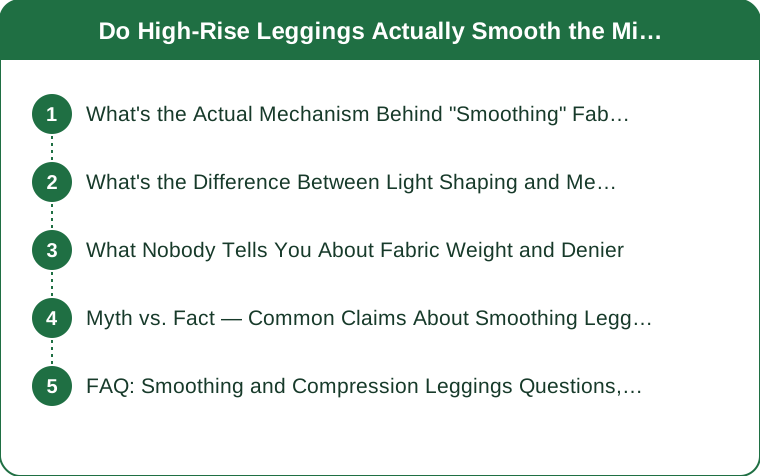
What’s the Actual Mechanism Behind “Smoothing” Fabric?
No fabric removes volume — this is true no matter what packaging claims. What structured, well-designed compression fabric actually does is apply graduated, even pressure across the midsection, which changes how soft tissue sits against your body rather than reducing it. Think of it less like disappearing and more like redistribution and containment: the fabric holds everything against your frame in a consistent, smooth plane instead of letting it shift and settle unevenly under regular clothing.
The key word is even. Pressure that’s applied consistently across a wide panel reads visually as smooth, because there are no sudden transitions in tension for the eye to catch. Pressure that’s applied unevenly — tight in one spot, loose in another — creates exactly the visible ridges and bulges people are trying to avoid, because tissue naturally moves toward the path of least resistance, meaning it pools wherever the fabric is not gripping.
This is why two leggings with the same stated “compression level” can look completely different on a body: one might use a single-panel, evenly structured front piece, and the other might use a thinner fabric that compresses hard right at the edges (waistband and inseam) while doing almost nothing across the middle — creating a smoothing illusion in photos but a bulge-and-squeeze effect in real wear.
What’s the Difference Between Light Shaping and Medical-Grade Compression?
These get conflated constantly, but they’re built for different jobs and use different pressure math.
Light shaping fabric (what most “smoothing” leggings use) typically applies somewhere in the range of light-to-moderate graduated pressure — enough to smooth surface texture and hold soft tissue against the body evenly, without restricting movement, digestion, or breathing. It’s designed to be worn all day comfortably and prioritizes an even, wide zone of gentle hold.
Medical-grade compression (like true compression garments used post-surgery or for circulation support) is measured in mmHg (millimeters of mercury) and is calibrated much more precisely and firmly — often significantly higher pressure, applied in specific graduated zones to affect blood flow, not just visual smoothness. It’s a clinical tool, not a style feature, and wearing something built to that spec isn’t necessary (or always comfortable) for everyday smoothing goals.
The confusion happens because activewear marketing borrows the word “compression” from the medical world to describe what is usually a much gentler shaping effect. Neither is better than the other — they’re solving different problems — but knowing the difference helps you understand why a $22 pair and a $90 pair described with the same word “compression” can feel completely different on your body. If a legging claims strong medical-style compression but is priced and constructed like a basic legging, that claim is very likely marketing language rather than an actual engineering spec.

What Nobody Tells You About Fabric Weight and Denier
Denier is a measurement of yarn thickness, and it’s one of the most reliable — and most ignored — indicators of whether a fabric can actually smooth or whether it’s just going to squeeze. Higher denier yarn is thicker and denser, which means the woven or knitted fabric has more structural resistance built into it before you even factor in elastane content.
Here’s the part that matters: a high-elastane, low-denier fabric can feel very “compressive” when you pull it — snapping back hard — without having the structural density to smooth evenly. It’s tight, but tight isn’t the same as structured. This is why some very stretchy leggings still show every seam, every underwear line, and every fold — they’re squeezing hard against soft tissue without a dense enough fabric structure to create a smooth, even surface across it.
Genuinely smoothing fabric usually falls in a heavier weight range with a tighter knit density — it feels thicker and more matte to the touch (as opposed to thin and slightly shiny), and when you stretch it between your hands, it resists more before giving, and returns to shape slowly and evenly rather than snapping back instantly. That slower, controlled recovery is a sign of structural fiber content, not just elastane doing all the work.
A simple in-store or at-home test: pinch and stretch the fabric between two fingers. If it feels like it has actual resistance and thickness — almost like a firm knit rather than a thin stretchy sheet — that’s a strong sign of real smoothing structure, not just compression.
Myth vs. Fact — Common Claims About Smoothing Leggings
Myth: “Tighter” always means “smoother.”
Fact: Tightness and smoothness are different properties. A too-tight, thin fabric often creates more visible texture and bulging at the edges because it’s squeezing unevenly rather than holding evenly. Smoothing is about even pressure distribution and fabric density, not raw tightness.
Myth: A double-layer waistband automatically means the whole legging is “shaping.”
Fact: A structured waistband (covered in our waistband-rolling piece) prevents rolling and provides support at the band itself, but it doesn’t guarantee the fabric across the rest of the midsection has smoothing structure. Some leggings have a great band and a thin, unstructured body panel — check both separately.
Myth: Smoothing fabric works the same on every body.
Fact: Because smoothing is about redistribution rather than removal, how it looks depends on your individual tissue distribution and the fit through the hip and waist — it’s not a universal transformation, it’s a tool that works with your body’s actual shape, and that’s a feature, not a limitation.
Myth: If leggings are marketed as “shapewear-level,” they must be extremely tight.
Fact: As covered above, effective shaping is about even graduated pressure and fabric density, not maximum tightness — some of the most effective smoothing fabrics are moderate in compression but excellent in structure and coverage.
FAQ: Smoothing and Compression Leggings Questions, Answered
How can I tell smoothing fabric from regular fabric before buying, if I can’t touch it?
Look for stated fabric specs: denier (higher is denser), fiber content percentage (higher structural fiber like nylon relative to elastane often means more structure), and words like “four-way stretch” combined with “opaque” or “structured” rather than just “stretchy.” Reviews mentioning “doesn’t show lines” or “holds shape all day” are also a good proxy.
Will high-rise leggings flatten my stomach the way shapewear does?
Not in the sense of reducing size — no fabric does that. What genuinely structured high-rise leggings do is create a smoother, more even surface line under clothing by distributing pressure evenly, which reads visually as smoother, but it’s a redistribution effect, not a reduction effect.
Is it bad for my body to wear compression-style leggings all day?
Light-to-moderate shaping compression (the kind in most quality activewear) is generally fine for all-day wear for most people. If you experience numbness, indentation marks that don’t fade quickly, or digestive discomfort, that suggests the compression level is higher than appropriate for all-day wear, and it’s worth sizing up or choosing a lighter-compression option.
Why do my leggings look smooth in the store mirror but not by the end of the day?
This usually points to fabric recovery — lower-quality elastane-heavy fabric loses its structural tension throughout a day of movement and body heat, so pressure that was even in the morning becomes uneven by evening. Higher-denier, better-recovery fabric holds its structure longer through wear.
TL;DR:
- Smoothing leggings redistribute soft tissue with even, structured pressure — they never remove volume, no matter what packaging implies.
- Light shaping fabric and medical-grade compression (measured in mmHg) are different tools for different jobs, not the same thing at different intensities.
- Denier (yarn thickness) and knit density are the real predictors of smoothing — high elastane alone creates tightness, not structure.
- Test fabric by stretching it between your fingers: real smoothing fabric resists and recovers slowly; thin compression-only fabric snaps back fast with little resistance.
Smoothing isn’t magic and it isn’t shrinking anything — it’s engineering, and now you know exactly which fabric properties to look for to get the real thing instead of the marketing version.
See It in Motion
Seen here: High Waist Yoga Leggings with Side Pockets — shop it on bubblelime.com
Keep Reading
This article is for general informational and styling purposes only. Fit, sizing, and product availability may vary.